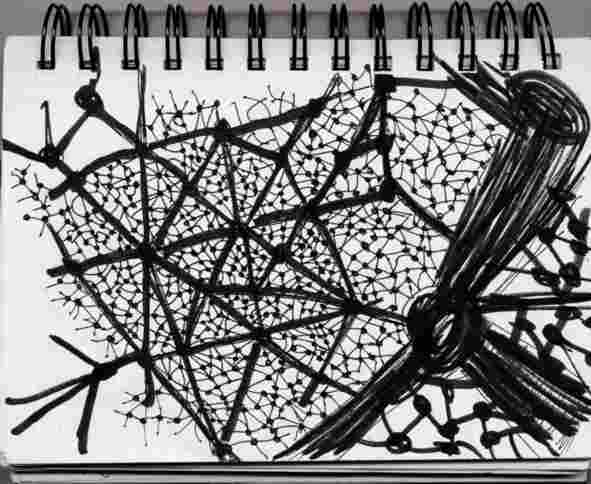
Illustration
1: Visualization of rhizomatic structure.
LAPTOP MUSIC
New Modes of Musicianship in the Age of Mobile Computing and Digital Networks
_ a research paper by Luka Prinčič _
SAE Technology College, London /
September, 2003 /
Table of contents
Introduction 3
Methodeoretical framework 4
Research question and methodology 7
1: 20th century music 9
2: Personal computer and the demoscene 16
3: Internet and free software: the network of freedom? 21
4: Recording industry in 21st century 27
5: Freed music and virtual audio publishing 32
6: Microsound community and laptop musician 36
Conclusions 40
Bibliography 42
Internet links 44
The background and impulse for this mainly theoretical endeavour is author’s participation in various musical settings, practical utilisation of digital tools, free software and digital networks for more than ten years. It has been observed in recent years an increasing use of mobile devices, especially general purposed processing machines – laptops in live and compositional musical situations. Frenzied communication of dsp specialists has been stumbled while playful exploration of free musical tools has been conducted on almost daily basis. At the time of creating first outlines of research it has been understood that by acknowledging the fusion of previously discrete practices a wide scope has been charted. This scope includes historical artistic and musical conceptual and practical developments, emergence of personal computer, Internet and free software, the demoscene and net.audio, contemporary issues of the music industry and present day instances of musicians with laptops. Researching Laptop Music as a cultural phenomenon has been a navigation through a terrain of cross discipline references, cross-historical practices and theoretical leads only to constantly uncover curious mixture of contradictions exerted by people in creative dialogue with their own creation: the (computing) machines. It is yet unknown if this sketchy map live up to its goals, but to be sure, it is hoped to be a modest contribution to a better understanding of contemporary micro-cultural musical practices.
Structure of this paper is divided into six chapters with a preceding discussion on theoretical points of departure and methodological concerns. The first chapter explores a historical view on musical developments throughout the 20th century that seem influential at the beginning of 21st. The advent of personal computer and the under researched topic of demoscene – community of computer audio/visual creatives – and pc’s immense transformational power is discussed in second chapter. The underpinnings and quick overview of development of the Internet are outlined in third chapter continuing into free software and Linux emerging phenomena and its consequences. Fourth chapter delves into difficult area of recording industry struggle with new disruptive file-sharing distribution technology, while fifth chapter explores a fairly unknown field of independent on-line virtual audio publishing. Last chapter offers an insight into inspiring ‘.microsound’ on-line community as a sketched community of laptop musicians and follows some other real-life appearances of mobile-technology-using musicians in recent years. In conclusion, an aspect of five fused practices of laptop music is presented to finish celebrating the phenomenon’s ambiguity.
An important part of this research is to define clear theoretical and philosophical points of departure which enable the intended kind of inquiry. It wouldn't be wrong to say that such a theoretical framework is crucial to the research and final text produced. Because the researched phenomenon – distinctively different modes of musicianship and the conditions of its emergence – is considered to be complex, fragmented, rhizomatic, and, in its final manifestations, seriously influenced by post-constructivist and ‘postmodernist’ intellectual styles (as well as, of course, postmodernism as a period), these are taken into consideration when outlining our basic positions. In fact, it seems to have been clear from the very beginning, at the creative moment of a search for the right draft-formulation of research questions, that traditional methodologies of social sciences will not suffice for understanding, not to mention explaining, the motivations and whereabouts of a ‘laptop musician’ – if we are to use such a general notion.
However, as the following research tries to show, the new modes of musicianship seem to arrive as a foreground to certain cultural changes. The socio-economical conditions that seem to have fuelled the spread of computer-based creative sound practices can be understood and explained through fairly traditional methods of inquiry of the past. Despite the suggestion that musicians themselves seem to hear the past a-referentially and in a highly ‘remix’ and ‘sampling’ kind of fashion, obvious historical facts and truths are not challenged here. The idea which the present text tries to imply is that new modes of musicianship that emerged through personal computing and digital networking can not be understood using traditional methods of scientific rigour, fetishizing the real and other forms of looking glass from enlightenment-based toolbox. In this context it is suggested that the phenomenon itself cannot be uncovered fully at all.
Thus, by now it should be clear that our points of departure owe a lot to the incoherent and often messy area of postmodernist (or pomo) intellectual challenges. Especially for social sciences, postmodernism could seem to be quite a tricky choice, given strong emphasis on relativism, rejection of fixed meanings and celebration of fluidity by researchers from pomo camp. The destructive nature of this framework in its radical form has been pointed out by many if not most involved in efforts to understand and explain culture. As Edles (2002: 199) puts it, “the notion that ‘reality’ is completely idiosyncratic and fluid, and that interpretation is completely open, undermines the very idea of doing cultural analysis. [...] Indeed, radical postmodernism implies that there are no patterns of interpretation or meaning, [it] denies the very existence of the cultural realm, i.e., that the creation and interpretation of texts relies not just on ‘subjectivity’ but intersubjectivity.”
However, there seems to exist some consensus within academic community, that pomo-inspired research can produce, if nothing else, interesting insights into culture. Usual common ground is that radical head-on challenges to any kind of authoritative voice claiming discovery, objectivity and fly-on-the-wall gazing of cultural phenomena are proving these voices false and outdated. Through this argumentation, orthodox realist-inspired research can be more sensitive to further pomo challenges. On the other hand, moderate postmodernists do agree, that using exclusively pomo ideas for research makes it impossible to talk about social world ‘out there’. So, at some point in between emerges a usable framework that is pomo-inspired and sensitive to its challenges, but aware of the very existence of culture and various possible standpoints from which social world ‘out there’ is still graspable and even explainable “without fetishizing the real”. (Seidman 1997: 55)
Thus, methodeoretical framework consists of key intertwined philosophical and theoretical references that form the main background for ‘the way we think’ while asking research questions on laptop music, new ways of music activity and surrounding cultural factors.
Looking firstly at themes of a more challenging and critical nature, themes that appear to be questioning the authority and realism, the centrality of discourse can be safely acknowledged. Through understanding of any discourse as a text, the constitutive powers of language are emphasised and ‘natural’ objects are viewed as discursively produced. Connected to language is also the critique of the idea of representation where “the indecideabilities of language takes precedence over language as a mirror of reality and a means for the transport of meaning” (Alvesson 2002: 47). Similar disruptive effect has an emphasis on fragmentation of identity, which represents the view of subjectivity as a process and foregrounds the death of the individual, autonomous, meaning-creating subject. The latter is replaced by the discursive production of the individual. Further in line with pomo thinking is the loss of foundations and power of grand narratives while instead multiple voices and local politics are celebrated. Finally, the power-knowledge connection is, at least, of interest, where knowledge is considered to be inseparable from power in a more or less Faucauldian sense.
These themes are fairly important, but at the 'low-brow' level (field practices) they are rather ambitious if not too radical. Alvesson proposes solution to this problem with a concept of reflexive pragmatism, which is a somewhat relaxed attitude to rigour and ‘holy cows’. It works by “navigating beyond empirical ambitions and methodological rigour on one hand and the kind of hypersceptical understandings of empirical enquiry encouraged by postmodernists on the other. [...] Reflexivity here works with a meta-theoretical structure that guides and interplay between producing interpretations and challenging them” (Alvesson 2002). Adding some more useful ideas to methodeoretical toolbox, we look into points raised by Laura Edles when exploring the comprehensive cultural sociology.
At the summary of that endeavour Edles roots the suitable framework for exploration of culture of today in acknowledging the importance of both structure and agency in a rather multidimensional way. Starting with a challenge proposed by Steve Seidman asking what social knowledge would look like, “if we abandon or seriously rethink a modern Enlightenment framework, if we no longer fetishize the Real” (Seidman 1997, as quoted by Edles 2002), Edles' conclusions are centred around the work of two important social and cultural analysts: Erving Goffman and Pierre Bourdieu.
Goffman's argued view on social reality is through acknowledgement of structure and agency: a focus on overarching social structures that in one way or another influence life combined with no lesser attention to individual agency. Despite Goffman's interest in subjective cultural schemas behind social organization – that he described as frames, he continually emphasized the power of social interaction of which “quality and character constitute the consequential reality of everyday life” (Brisset and Edgley 1990, as quoted in Edles 2002). For various researchers the concept of frame can be developed into multitude of directions. However, Goffmanian approach seem to be characterised by multidimensionality, where interpenetration of collective structures and individual agency are foregrounded. One should be, then, vary of easily disregarding the intersubjective cultural ‘field’ where discursive interaction ‘games’ are played.
Work of French theorist Pierre Bourdieu is difficult to summarize, but many would agree that his most important work is centred around relationship between culture and power. He combines a “Goffmanian concern with people's improvisational, practical mastery over complex logic of everyday life with a neoMarxist concern for the reproduction of inequality” (Edles 2002). However most interesting for the direction of our research is Bourdieu's methodological reliance on all sorts of qualitative and quantitative data. It is usual to find extremely varied types of information in his work – ranging from ethnographic observation, literary texts and photographs to statistical surveys and questionnaires. Theoretically, Bourdieu's forging of his concepts as correctives to opposing viewpoints serves as an inspiration in theoretical acknowledgement of fluidity and existence of ambiguities in social reality.
A concept of human-social-historical-reality, developed by philosopher Wilhelm Dilthey, is approached here in a somewhat schizophrenic fashion in a Deleuzo-Guatarrian kind of sense. In other words, it is a hermeneutic version of postmodern deconstructionism, or rather, an experiment in fusion of the two frameworks circling and bouncing between antipositive knowledge produced by pomo thinking on one, and constructive “how things could be understood” line of comprehensive cultural sociology. Pomo offers a challenge and an inspiration to revise and make qualitative research more challenging and creative. At the same time, comprehensive sociology proposes that more is gained if, rather than assert “objectivity” or retreat to “subjectivity”, we intensify our systematic, interpretive search for the real – or hyperreal. Taking this methodology into account, consequential aim of this research is to produce an informed and possibly sophisticated 1 text.
First formulation of possible approaches to the “laptop music” phenomenon included an ambitious idea to fully identify and research the laptop music as a social reality, isolated from contextual and temporal frames within which it seems to exist. This thesis-approach quickly raised two problems. The size of the project and referential multidimensionality required resources unavailable to Honorous BA student. To cover – explore and explain – laptop music as an emergent social and cultural phenomenon would be possible only in a post-graduate or similarly supported situation, where enough time would be available to conduct research with an appropriate speed. Secondly, there appears a strong case against fixed and direct one-dimensional uni-vocal causality of socio-economic and historical 'facts', causality raised and isolated from its contexts. The simple physical appearance of musicians with laptops in one setting and various musical practices without direct relation to laptop performance in other, suggested that “laptop music” as a myriad of cultural musical modes is much harder to pin down than, for example, an empirical research within natural sciences. This appears as a classic sociologic dilemma, but, as it is argued in previous chapter, it isn't just a bewilderment over complexities of social world that is preventing this research to rely on ‘usual’ empirical frameworks, but also a resistance to suppress ambiguities in order to “discover” universalities.
Illustration
1: Visualization of rhizomatic structure.
Thus, the ambition of full identification and ‘total’ research is, if nothing else, inappropriate as a goal. So far, it became clear that rigid ‘thesis-style’ of research is in this case inapplicable, and the question becomes: what kind of research question can we put forward in order to approach the phenomenon as appropriately as possible? Which is the appropriate and possible approach? What kind of questions can we ask about laptop music? This research, in fact, tries to propose an (informed) appropriate background from which more detailed – theoretical and interpretive – research can be conducted. It asks a question: which socio-historical and cultural developments conditioned the emergence of laptop musician, a musician which primarily uses one technological device – a personal computer or laptop – connected to digital networks, conducting research (self-education), composition, innovation, performance and distribution of his musical works, many times simultaneously? And as much as scope permits, what are manifestations and direct consequences of this seemingly self-sustained creative activity? Here, in fact, the question represents a notion which is in fact already a basic ground for the research. A hypothetical reality.
Methodologically, the research can be observed as multitude of various approaches towards gathering of data, or in pomo terms: searching for inspiration. The analysis of amounts of messages on various electronic mailings lists, participation in the dialogue on them, performances at “open wire” events like London's Plug'n'Play, visits of number of events that included laptop performances, all these actions by author-researcher could be understood as participant observation. Under the same heading would as well suitable fall active participation in national Slovene demoscene, and partially within the international counterpart, as well as many years of sporadic and hobbyist research of virtual audio publishing that emerged from the music side of the demoscene. Discourse analysis is seen in critical observation of web pages, literatures, various electronic files with textual and graphical content, demomags (some kind of cyberspace counterpart of fanzines). Email interviews in form of private correspondence are conducted with various contemporary musicians, demoscene programmers, runners of Internet music labels, artists and authors. Although the methodology seems systematic in general view, it is not considered as such in whole. Concerns put forward in methodeoretical chapter are fully acknowledged in that mentioned methodologies are sometimes Methodology is here understood as multidimensional, critical as well as interpretive, hermeneutic and equally aware of structure and agency.
In sum, the theory and method, then, serve as both a means to, and constitutive of, the exploration of conditions that seem to be instrumental in emergence of new modes of musical creativity which are called laptop music. The points raised with postmodern challenges and methodologies exemplified in area of cultural sociology inspire less rigid and somewhat more imaginative and creative research. These theoretical concepts are forged for use as tools in navigation of a terrain whose ambiguities are seen as an important contribution to emergence of laptop music. To be sure, the focus on laptop music here is not as a musical genre, neither exclusively as a performative practice, but rather as a nexus of historical echoes, artistic reverberations and contemporary sequencing of computer music microcultures with the Net and its hacking origins. Far from being uniform movement, laptop music can be most accurately visualized as a rhizomatic mindset, thousand connecting plateaus of free musical thought and action.
The relationship of society towards music in 20th century has been gradually and increasingly transformed by two technological inventions. Electromagnetic wireless emissions at high frequencies employed as carrier of human voice and music, in other words – radio, and inscriptions of sound onto wax, aluminium and black vinyl plastic by means of a vibrating needle creating indentations or grooves. At the time, both of these inventions were hailed as revolutionary, intended for mass production, immediately marketed and surrounded by strong enthusiastic ‘visions’ how this technology could be used to make a world the better place.
In 1877, using tin foil wrapped around cylinder, Thomas Edison created a first phonograph that recorded sound. His idea was later improved by various scientists and researchers like both Bell brothers (Alexander and Chichester) and Charles Tainter, who all used wax instead of tin foil to create graphophone. But more significantly, a German immigrant in US, Emile Berliner, patented a ‘sideways modulating’ groove-etching recording device using discs that was called grammophone, in year 1887.
On the other hand, precedent for early radio devices, fuelled with Faraday's experiments and Maxwell's electromagnetic “laws”, were created by ‘wireless hackers’ Marconi and Tesla at the end of the century: “in 1899, after five years of fiddling around with induction coils, batteries and primitive aerials (some of which he hung from balloons), Guglielmo Marconi equipped two ships with radio gear that issued speedily telegraphed reports on the yacht race for the Americas Cup. This little sports thrill captured the worlds imagination, and the 20th century can be said to have started on a wireless note.” (Davies 2002: 20)
From the first “juke box” – a coin operating cylinder phonograph with four listening tubes – set up in Los Angeles in 1890, to first US advertisement for “High Fidelity records”, and a “Duo Junior record player” attachment for radios sold for $16 in 1934 (Schoenherr 2003), music and sound began to be mass materialised. Similarly, through proliferation of radio up until second world war, music and sound began to be mass communicated.
The two brotherly ideas of mass materialization and communication of music and sound represent the roots for major shifts in attitude of society. Relationships towards understanding, experiencing, consumption of, and entertainment by, music and sound has then radically changed. Gradually, radio and gramophone replaced the piano and singing in people’s homes. Music recordings of operas and symphonies (and later more and more pop-ular music) could be bought in shops and brought home or to a friend for listening in family environment. While at one hand, this brings benefits to lower classes who suddenly get access to sophisticated and high-brow music, on the other hand popularisation and mass production fuel the era of popular music and ‘pollution of purity’ of classical serious music, which in effect becomes ‘art-music’. Radio transmission of music are understood critically by, for example, Theodor Adorno as “avalanche of fetishism which is overtaking music and burying it under the moraine of entertainment”. (Adorno 2002: 252)
Similarly, and probably not coincidentally, understanding and a pursue of art is marked by basic requestioning of creative expression, especially its role, form, content and various contexts within which it operates and gets voiced. One of many radical departures from, and rejections of preceding music and art practices (mainly in the shadow of Beethoven's romanticism) was the Art of Noises manifesto by Italian futurist Luigi Russolo in 1913. Apart from the manifesto which he founded on avant-garde sentiment: “We delight much more in combining in our thoughts the noises of trams, of automobile engines, of carriages and brawling crowds, than in hearing again the Eroica or the Pastorale” (Russolo 1913 as quoted in Kahn 2001: 57), Russolo's impact on, though scattered, whole 20th century also lies in his practical execution of futurist ideas thought the design of then-new noise-intoning instruments, the intonarumori, and new forms of notation for them. His radical break into noise provoked positive or negative reactions of many composers and musicians, including Debussy, Stravinsky, Satie, Milhaud, Honneger, Varese, and Cowel. It had an impact on aspects of the Russian avant-garde and Vorticism in England among others. The influence of Russolo's noise eventually waned but was then revived in the wake of musique concrete in the 1950s and has become widely recognized as a precursor to a range of artistic activities as the second half of the century rolls to a close.

Illustration
2: Luigi Russolo, Dynamismus eines Automobils (1912/1913)
“Any sounds of any sorts, and in any combinations are natural and conceivable within a rhythmic structure which equally embraces silence,” wrote John Cage in an article Forerunners of Modern Music published in 1949 (Pritchett 1996: 47). As a prelude to his even more radical views and avant-garde compositions throughout the fifties, he sets an important precedent: any sound in any combination can be music. With a constant desire to challenge basic elements of music, i.e. structure, form, material and method, with regard to the duality of law and freedom, Cage introduced different understanding of music and compositional methods.
Cage wanted to escape, for some, the dead-end of tonal and even atonal music that loomed above the composers of the time. Atonal music – in form of serialism of Schoenberg, Berg and Webern – introduced only a methodological change (and no structural means) that nevertheless affirmed the kingdom of tradition by forcing composers continually to make negative steps – in efforts to avoid unwanted combinations of sound. By observing four determinants of sound – pitch, timbre, loudness and duration – with regard to duality and necessity of sound and silence, Cage stressed that it is only duration that is common to both sound and silence. Following from that, he radically declares that the only “correct” structure is the one based on durations and not on pitch of a sound. (Nyman 1999) One of the consequences of this single, for traditional music demolishing, stroke is that silence, the – at first presumed to be – non-existence of sound, – but later2 – the silent and unintended sound, becomes of equal importance as traditional pitched ‘tone-sound’.
A composition commonly first associated with John Cage is 4'33'', also known as the silence piece, in which a musician sits at the piano and lifts and closes the keyboard lid to mark the beginnings and endings of three parts of the piece respectively while sitting still during it. In fact, and contrary to popular belief of the ‘uninitiated’, 4'33'' is a demonstration of the non-existence of silence, of the permanent presence of sounds around us, of the fact they are worthy of our attention. The silence piece is not a negation of music but an affirmation of its omnipresence. Or, as Douglas Kahn puts it, the tactic implied in 4'33'' entails “rejecting the importance of whether a musical sound was present or absent within a composition and, in the process, extending the field of artistic materiality to all the unintentional sounds surrounding the performance – that is, by shifting the production of music from the site of utterance to that of audition” (2001: 158, emphasis added).
Another concept, or view on music, as well as a part of compositional 'toolkit', that was most prominently started by Cage and was embraced by number of artists, musicians and creatives throughout the century, was a processual technique using chance. Through need to free the music and sounds, composers of experimental music3 used various chance techniques when creating scores. For example Cage used to consult the Chinese Book of Changes text I Ching most frequently to decide on various aspects and directions he needed to take throwing a coin or a dice. By bringing in the chance as a credible and desired part of the process of creating a score, mid-century music took a radical shift. The basic question asked became: who's in control? Which is exactly the point of freeing the sound and music that was so much desired by those feeling trapped in the polarity of western modal harmonic music system. Furthermore, releasing and spreading the decision-making process into the site of performance by instructing the performer to decide on, for example, order of pages of score to be played, opened another possibility for changes in structural means for the new, experimental music.
Chance and indeterminacy suddenly taking a central role in creative process at the time meant that monumentality of a work of a an author, a genius, started to loose its blind romantic influence. The control and fixation of the work was not desired any more. What seem to echo from that time to the end of century is a search for non-narrative, processual, non-linear, fluid and open work[space]s that [re]question authority, ideology and superficiality of a man over nature and life. Cage and others of the his time, wanted to discover the means to “let sounds be themselves rather than vehicles for man-made theories, or expression of human sentiments” (Cage 1957 as quoted in Nyman 1999: 51) It appears to be an influential time, bringing about the philosophical shifts: “Art's obscured the difference between art and life. Now let life obscure the difference between life and art.”
Until the invention of a device that recorded – therefore materialised – sound, certain dimensions of thinking about sound, voice, music were simply not possible. It was unimaginable to conceptualise about sound as something attainable: fixed and materially objective. Under influence of the futurists and later symbolism, with a new position within French RadioTelevision (RTF) and latest technological inventions and devices at his disposal, Pierre Schaeffer started to uncover the possibility of a different understanding of sound: the syntax of a sound object. With his persistent inquiry into ‘fundamental issues of musical communication’ (Dack 1994), a different possible dimension of audial expression emerged.
Schaeffer's basic idea of musique concrete was to use recorded sounds and recorded sounds only as source material for music. As it “disrupts the system of actual and potential meanings” (Kahn 2001) by making the sounds unrecognisable, the practice becomes similar to abstract painting. Many scholars outrightly dismissed Pierre's diligent efforts to create a musical taxonomy of concrete sounds, to which, very possibly, further contributed Schaeffer's own dismissal of his entire career, however many, even himself, fail to recognise his contribution which is valuable precisely because he was not trained musical composer. To ask questions on the nature of musical communication, from an radio-engineering point of view, from the outside of the musical system, created a possibility to not even think of music but still create sound, which can function as music or not. As Schaeffer himself: “Musique Concrete in its work of assembling sound, produces sound-works, sound-structures, but not music” (Kahn 2001: 110). In other words: a possibility to further explore the borders of what is, and can be music.
It would be daring, but nevertheless possible to say, that the ideas behind Musique Concrete are unsuitable to resonate with modernist/avant-garde ‘authority’ and polarities of a/referentiality and freedom/control. Especially within theoretical frames, even until now, Schaeffer's work and ideas have not received enough recognition and proper analytical attention. At the same time, it is telling that his GRM (Groupe de Recherché Musicale) studio has been known as an influential 'test-bed' and starting point for many of the prominent experimental and avant-garde composers in the mid-century. In practice, therefore, Schaeffer and his ideas were pioneering and strongly influential and the reverberation continues even until today.
One of the visitors of GRM studio and Schaeffer's collaborators was also a German avant-garde composer Karlheinz Stockhausen. To leave ambiguity of father of musique concrete behind and to confront Stockhausen with experimentalism of John Cage, hear how Nyman puts it: while experimental composer is interested in uniqueness of the impermanent moment, his avant-garde opposition is an interest in uniqueness of frozen moment, which makes “its uniqueness un-natural, a jealously guarded possession” (Nyman 1999: 9). This illustrates the various approaches and its consequent methodologies and explorations of 20th century composers.
Stockhausen is a heavy name for his exploration of electronic sound and relationships between noise and tone. He studied with Messiaen and worked with Edgar Varese and Pierre Boulez, but is at the same time claimed to be an influence to a diverse range of artists including Beatles, Kraftwerk, members of Mothers of Invention, and Aphex Twin. In fact, most agree he has influenced every twentieth-century composer, especially with his compositional techniques, that had astounded and befuddled his contemporaries, as he moved from conventional to serial to formula and beyond. Even acidplanet.com, a community website for users of consumer-level music software ACID, ran a ‘Stockhausen Composition Contest’ in collaboration with ‘the professor’ in 2002. Notably, Stockhausen has been one of the first to use electronic sound and worked with complicated synthesizers in studios of national radios. His “four criteria of electronic music”4 remain an invincible reverberation through the end of century electronic music.
Through the twentieth century a visible rise of culture industry is happening, an industry bound and feed off the desire for the new, electrified entertainment. The peaking of industrial revolution, becoming-electromagnetical, and all the technological inventions that intensely commodified cultural artefacts. Music was not played and ‘read’ at home, behind the piano, but bought in the shop and brought home to listen to in peace and tranquillity. Transmission of opera through the radio eliminated the need to socialize in big opera houses in clumsy dresses. At the same time, high-brow culture reached the ears of the unprivileged, poorer country town areas, where an ‘average peasant’ could access high culture like operas, symphonies and radio-plays.
Issues surrounding these changes were taken into a heavy consideration by a German thinker that immigrated to America and was part of circle called ‘the Frankfurt school’: Theodor Adorno. His critical theory, with a good amount of focus on music, its commodification, transformation into a consumer good, is, as seen from point of today, many times under the burden created by the horrors of consequences of fascism and dictatorships. At the same time, it opens a critical stance towards the popular, to asses commodification by the industry, be it music, film or books, as critically as possible. Critical theory is often inclined to exclusive and absolute assertions, but is at the same time valuable in understanding the roots of resistance to hegemony, and how resisting forms of artistic expression appear in order to re-question the commodification and industrialization.
One of more important consequent socio-musical conditions that emerged in the middle of the century for an art-composer, a composer of serious music, was that he became more and more alienated from the audience. As composers searched for new sounds, radically different compositional techniques, that freed the music, brought indeterminacy, chance, atonality and noise, audience kept being more and more entertained by the energy of jazz, rock'n'roll, blues and other ‘precarious’ songwriting that was easily put on the record and radiowaves. This audience less and less understood the art-music of the century, as it was, in fact, becoming rebellious and resisting.
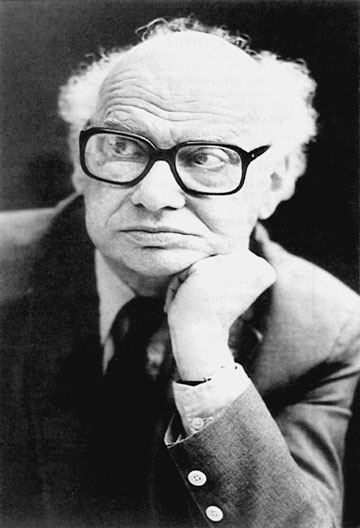
Illustration
3: Milton Babbitt
A musical sociohistorical view of twentieth century offers a picture, a sound of rumble, changes, transformations in many aspects of peoples' lives. Taking in consideration the “aural” plane – the music, sound and audio – and methods, techniques of creative expression, that are closely tied to various art-istic challenges redefining the art itself, it is possible to hear the remixing of the two influential shifts. They are like two matrices of various forces, writings, happenings, protests and manifestos, echoing up to the end of the nineties of the century.
Firstly, the redefinition of art, most vividly exclaimed by Marcel Duchamp's urinal put into the gallery as an [ready-made] artwork. It is of course the one that signifies the challenges but is not representative of them. In other words, Duchamp's action drives into the open just one of many questions that tortured creatives of the time. From the Futurists all through the Dada, surrealism, abstract painting, John Cage, avant-garde, minimalism and Fluxus [among many], until the very 'contemporary art' of today, few are really interested in creating a grand narrative, monumentality of power to achieve the beauty and materialize a message through a metaphor. There are of course contra-arguments and important exemptions to this, and even intra-contradictions, but the fact is, most of the art [in a quite loose sense of the word] of twentieth century has a central theme of testing the boundaries of artistic expression by shifting basic structural and methodological concepts while reflecting on collective and individual cultural reality. Challenged are constituents and existence of notions like author, institution, representation, nation, power, state, media, economy and the individual self.
The second influential matrix is a large intertwined knot of post-colonial anti-ethnocentric cultural studies, feminist challenges to the legacy of white male history, and post-structural philosophy of power and discourse. The neural cortex of these has connections to so much touted postmodernism in various forms, especially the intellectual style and pomo as a period – a lifestyle. Especially the latter – postmodernity, is the one representative of changes in everyday life, of cultural 'reality' which most of mentioned disciplines – art, creativity, thought and philosophy – focus on.
So it can be heard: sound of twentieth century is one of shifting values, sliding perceptions, crushing authorities, and rejecting originality. It is of challenging fixation and referentiality, contradictions and truth, relativity and the Absolute living in the romantic soul of post-industrial consumer.
One of the crucial moments of a wide spread of personal computers – processing machines suitable for home use with appropriate software – was when they became available together with games.6 A fairly probable idea exists, tried in multiple disciplines like economics and social sciences, that the basis of constructive advancement of human society is play. To mingle, explore, break rules, compete, innovatively create and to use imagination in variety of ways could be seen as the basis of progress, psychologically as well as culturally. In the same way as it happened with early Internet boom by introduction of electronic mail that immediately took over the majority of the tcp/ip traffic, similarly was a personal computer embraced by home users when it offered gaming, entertainment and, soon enough, digital connections possibilities.
In 1943 Thomas Watson, then chairman of IBM, outed the infamous quote, “I think there is world market for maybe five computers”, he said, and after thirty years everything was the opposite. Already in 47' a first point-contact transistor was made, and a bipolar junction transistor in 1950; two deciding points on the path to minituarization and greater flexibility in manufacturing of computing machines. All the way through number of 'firsts': integrated circuit (1958), field-effect transistor (1962), static and dynamic RAMs (1970) and a batch of microprocessors: 4004, 8008, 4040 and 8080 (1971-1974) made by Intel, of which was the latter followed by the explosion of microprocessors and microcomputers, until the the infamous Apple II in 1977, whose company, Apple Computers, jumped to the forefront of the sudden pc market niche by earning huge 7 million dollars in first year. When IBM launched their first PC in 1981 for bare $1.365, it was clear that personal computer trend was not “just a fad that will never catch on” (Maxfield and Brown 1997, emphasis added).
Watson's exclamation is, of course, through some view, a valid one for the time. As many describing the development of field of computers in second half of twentieth century acknowledge that in 1942 computers were very big, very expensive and very difficult to use. Just for illustration of this fact is the near-historical etymology of the term computer bug, that comes from a failure of one of ancient computers running on vacuum tubes into which an actual living bug of some sort found its way and caused a major disruption by burning on hot tube.
In the eighties, many of the kids in America and Europe got hold of an affordable home computer, be it Apple, Commodore, Atari, Amiga or even IBM's compatible PC. One of the attractions were of course number of computer games that come with it, or were accessible through outlet shops, as well as bundled simple programming languages – like Basic. This is the point where The Scene starts to take shape. The term is a general one, but what it implies is, as opposed to The Industry, that social relationships are based on strong emotional connection to a common cause, in most cases unconnected to material goods or exchange of wealth. The Scene has more a smell of specialist, lesser known knowledge, understanding and passion. Usually there is a system of peer review that is a means of acknowledgement of one's skills.
A body of research was done on field of so called computer underground, especially in connection to malicious hacking, cracking, corporate systems intrusion and phone phreaking7. However there is a kind of peripheral activity at the side of the very clearly definable ‘radical’ computer underground, a more visible and less blatantly criminal form of it. Despite of possible offensive prosecutions by the authorities, pirates and crackers were somehow always visible. The notion of the Scene describes a network of computer- and network-knowledgeable individuals that exert considerable interest in computer systems, software protection methods and techniques to crack them. Skills and brave, seemingly impossible achievements are the currency of this underworld. To gain peer recognition, information about tools and breakthroughs must spread quickly and undeniably. Therefore sharing of information, home-made scripts and programs is crucial. This mode of functioning, non-hierarchical, unregulated, hidden, but yet accessible to those wanting enough to be part of it, combined with decentralized communication network, be it word of mount, bulletin board systems, or Internet, fulfils some of the dreams and prophecies of socially critical sci-fi literary genre of the eighties: cyberpunk,8 which later inspired a whole ‘real-life-style’, namely with phreaking and cracking.
While most of adventurous and sometimes illegal explorations of computer systems, its backdoors, secret tunnels and programming languages did not function as a kind of productive step towards, for example, artefacts of creative practice, there was a little niche from which a somewhat different scene, a very creative scene sprung up. One of the activities of the computer underground was also cracking the copy-protections of games and distributing this “wild” copy as further around as possible. Not much insider (or in-depth, for that matter) research exist, but cracking and copying of games and other software became a way of getting recognition soon after the introduction of first games and software for home personal computers. Those in the scene exchanged copies of cracked games or software, which came from the one who cracked it, which got the originals from the suppliers. ‘Couriers’ were the ones who distributed games or other software – releases – further around. Groups started to form and competition for speed and quality9 between them sprung up.
Crackers and cracking groups needed to sign their releases somehow. At first these were just added sentences to the title of the game, in smaller captions, or, as defacto2.net explains in its insider paper: “In the eighties many cracks where usually created by individuals rather then groups (groups being a collection of people who work under the same name). These individuals would normally leave a signature in the release to identify themselves as the cracker. For example on a game's title screen you might see in the bottom corner ‘cracked by Lord Blix’” (defacto2.net/monolog.cfm 2003).
After cracking/pirate groups were being more frequently formed they increasingly included a graphic artist and/or a musician (or more of them) apart from the programmer who looked into visual programming routines10 in order to create visually more appealing signatures. These quickly evolved into animated screens, including greeting text, aliases and handles of members of the group, and sometimes even various different scenes/sequences and music. Because floppy disks were small at the time, and, later, modem lines were slow, these additional “introductions” – soon called “intros” or “cracktros” – were deemed to be as small as possible in terms of bytesize, so that they would not present an additional downloading frustration. In fact, this limitation soon presented as a challenge to coders and musicians.
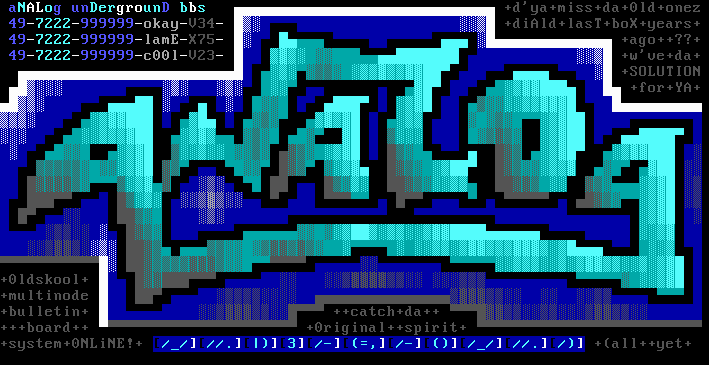
Illustration
4: Analog Underground BBS entry ANSI graphics
“It all began one sweet day in the early 90s. A friend of mine did show me a computer which I didn't know so well before. It was an Amiga 500 and he was a graphician in the illegal Amiga cracking group Angels. As he was also mailswapping with other freaks by abusing his PLK, he had a good source for new games. And then it happened. I was infected by a virus that still has its influence on me from that day on until today. The illegal Scene looked very mysterious to me. A sort of underground, a complete different community with own rules. Things you could only learn from somebody that already takes part there. A few years later a good friend of me introduced me into the rules of the /X (Amiexpress) board Scene, I began trading and later drove a bbs on my own. In the year 1993 my interest changed into the demoscene but I never lost the contact to the dark side of the moon. ;-) ”
(diskmag.de 2003)
Demoscene has been fuelled with digital communication possibilities, at first with bulletin boards systems (BBS) utilizing modems, phone lines, personal computers (as opposed to Internet servers) and simple ‘home-coded’ software, and later in the mid-nineties the Internet. The first BBS programs were written for Apple II home computer in the late seventies. Buggy, slow and bloated11 they provided exchange of messages of anyone who called-in. These programs, mostly written by individuals, allowed for a home computer to answer the phone call by another computer and provide an interactive interface to a dialler (user of a computer dialling in) and offer number of services like message boards, file transfers (uploads and downloads), real-time chat and games. By the course of sophistication and new ideas, these systems started to call nearest neighbouring bbs once or twice a day and exchange [synchronise] messages in specific “conferences”. A worldwide network of such systems emerged in late eighties, called FidoNet, that was so successful in transcending crossnational boundaries that could not have been superseded by anything else than Internet.
Bulletin boards offered fast and semi-anonymous way to share cracks, pirated material and demoscene productions (not to mention cyberpunk texts, phreaking tutorials, hacking tips and cracker's scripts, among others), a first glimpse of cyberspace – a possible, and in fact a real computer underground haven. Generalisation of BBS usage is, of course, precarious. BBSs sprung up to offer communication at ease with geographically separated individuals and marginalized groups that would hardly ever manage to organise a ‘inter-continental’ meeting. These systems also fostered enthusiastic spread of various demo releases and hectic development and forking of its formats. Intros and demos quickly became independent audiovisual forms as well as ASCII, ANSI, pixeldrawn and rendered graphic works. Music itself started to be released independently in a form of so called modules.
The sceners, now mostly independent of pirating scenes, continued to form groups, distribute releases of independent works and even create coded interactive digital magazines – diskmags. The evolution of the demoscene creative forms, social structures and means of engagement is constructed through two channels: already described utilisation of digital networks and the physical gatherings of 'members of the scene' – the demoparties. The demoparties consist of various competitions classified in appropriate forms (intro, demo, music, pixel-art), at-place coding, drawing, composing and collectively creating the artefacts and exchange of personal contacts through various social techniques12. The demoparties are organized regularly in order to gather the scene (the demomakers) for several days, usually not more than three or four days. The biggest parties are known to be The Assembly in Finland, The Party in Denmark and The Gathering in Norway13. These gather from 3000 to more than 5000 participants. Despite of US being superior in information technology, the demoscene cradle is Europe with maximum activity on the north. According to Orange Juice, the demoscene information centre, there is an average of one party per week in Europe (ojuice.net 2003).
Under influence of possibilities of Internet connections, personal web pages and increasingly transparent global communication through chat rooms and electronic mail in the mid and late nineties, Demoscene flourished easily. With the trend of expansion came a trend of forking. Thus, combined with higher transfer speeds the music scene gained independent groups that were only releasing music in a ‘tracker module’ format. As opposed to more common streaming/digital audio which is in essence a recording, tracker modules were created with software called trackers and included separated sounds and score to which those sounds are played in real-time in a multi-tracked way. These module format was a necessity but at the same time an invention of the scene14 to deal with small file size requirements and the real-time inclusion in coded visual routines. Consequentially of these technological limitations, some distinctive features of music made this way were obviously heard, so that a possible research of it could result in description of a separate genre, sometimes using 8-bit samples and small amount of available parallel compositional tracks resulting in low-resolution distortion used in a creative way.
Essentially, demoscene is an anarchical, peer-reviewed, worldwide community of makers of real-time-executed audiovisual non-interactive artefacts that test the limits of technology and use programming knowledge, both available to an average kid with a home personal computer. The community develops its own software tools and uses free communication channels for distribution of works, tools and knowledge. As in science where a wide distribution of achievements is necessary for peer review and quotation, the demosceners fully acknowledge the freedom of distribution of the artefacts and therefore is their work available for downloading, storing, and viewing free of charge and permission for non-commercial purposes15. The motive for months of collectively coding (programming) the demos only to show it the the demoparty, to participate in the competitions and to release it to the public, seem to lie in the challenge of breaking the boundaries of the available technology, learning, peer recognition, sharing of ideas and competition.
TCP/IP, the Transfer Control Protocol/Inter-network Protocol, one of the building stones of the network of computer networks, of the transparent informational architecture of the cyberspace, came into being as a need to connect different networks between each other, networks that used directly inter- incompatible protocols. This protocol was designed to be a glue between computer networks of almost any type. As any invention, it drew from number of previously accomplished networking endeavours, mainly between universities but not excluding European and even Hawaiian research centres and computer networking efforts.
In his extremely insightful book The Internet Galaxy, Manuel Castells sources the birth of the Internet as “the unlikely intersection of big science, military research, and the culture of freedom” (Castells 2002). Indeed, the protocol was a consequence of the need to connect ARPANET with other communication networks US' Advance Research Projects Agency (ARPA) was managing in mid seventies16. ARPANET came into being as part of an aim of Information Processing Techniques Office (IPTO, one of ARPA's departments) to stimulate research in interactive computing as defined by Joseph Licklider, a psychologist turned computer scientist at the Massachusetts Institute of Technology (MIT). As part of this effort, the building of ARPANET was justified as a way of sharing computing time on-line between various computer centres and research groups working for the agency.
TCP/IP protocol was effectively developed by number of scientists through various cooperative technical groups with one single aim: to establish a standardised protocol that will not “care” what will it transmit, as long as packets of information reach their destination in a highly decentralized way. Decentralization was a crucial characteristic of computer networks, as this meant much more efficient and faster transmission of data between various computers. At least at a basic transmission level. On top of TCP/IP various levels of other communication and application protocols could be created (e.g., authentication, identification, interaction, control, multimedia streaming etc). However, one of the most controversial properties of this protocol was its high efficiency to route packets of data around obstacles, broken lines, off-line routers, etc., without central control. This feature made constitutive basic protocol of the Internet such a revolutionary invention.
“All the key technological developments that led to the Internet were built around government institutions, major universities, and research centres, The Internet did not originate in the business world. It was too daring a technology, too expensive a project, and too risky an initiative to be assumed by profit-oriented organizations” (Castells 2002).
However, as John Naughton points out, it would be a mistake to only resort to theories about the computer communication protocols or “the mechanics of digital replication to explain why the Net is different from anything we've seen before. For the conventional definition describing it as a global network of computer networks contains an elementary schoolboy mistake. It makes no mention of people.” (Naughton 1999)
In early eighties, an MIT hacker17 Richard Stallman saw the collapse of the community of programmers at MIT artificial intelligence (AI) lab, which he was part of. At the time the lab bought a new time-sharing computer that used a proprietary operating system from Digital, for which those who worked with it had to sign a non-disclosure agreement, many of the original programmers left the lab for various reasons. Stallman found himself in a new, awkward position in which he was not allowed to share the code, the software on which everybody worked for everyone's good. After the visit to a company that made a printer that was used in the lab, to get the source code18 for the printer driver in order to improve it and got his request rejected, he realized the world of software is radically changing.
Until then the community of programmers that worked in specialized computer environments, usually closely bound with scientific research, considered software-sharing as natural as is sharing of scientific findings in order to contribute to further research, development, progress. With introduction of a new market of personal computers, it was possible for software to become a commodity. In order to return the costs of commercial development of software like operating systems, printer drivers and games, companies employed various techniques to licence the single copy of software to the user under certain limitations and conditions. For Stallman, this was, and still is, ethically wrong.
Stallman understands software as closely tied to social realm. For him a proprietary-software social system – the system that says user is not allowed to share or change the software – is effectively antisocial. It is based on dividing the public and keeping users helpless not being able to even help each other. He rejects the purely utilitarian viewpoint that the only important thing about software is what jobs it allows user to do, as well as an assumption that usable software would not exist without giving companies power over the users of the software. At first, these resisting positions seem to be far fetched, but in context of increasing 'symbiosis' and interpenetration of various kinds of software into every-day life in post-industrial information society the question of control is in fact very appropriate. Stallman's resistance ultimately provokes a question of weighting between freedom and market, ethics and profit.
This MIT hacker decided to listen to his ‘moral’ voice and set on a path of freeing the software. More precisely, to create truly free software, free as in freedom. As part of his endeavour to write a free operating system, complete with basic tools, he had to invent a way to assure the code he'll write and free cannot be un-freed in any way by anyone while still retaining the freedom for everyone. He created a general public licence which assured that the code that is licensed with it can be freely run for any purpose, modified and redistributed, including modified versions of the code while forbidding removal of the licence.19
The GNU GPL licence, named after the name of Stallman's operating system (by hacker's tradition a recursive acronym: GNU's Not Unix) created a legally extremely powerful tool that effectively protected software that was intended to be (in whole and in part) a free software by its authors. Although often referred to as copyleft, it is not the opposite of copyright, but rather its upgrade. It simply removes some of its effects. For GPL to actually be put legally as a licence onto a certain work, that work has to be copyrighted first. In other words, without copyright there would be no (need for) copyleft.20
In 1985 Richard Stallman founded Free Software Foundation, continued to work on GNU operating system and travelled the states and, soon, the continents to give lectures on free and ethical software. Soon enough like-minded followed and programmers increasingly found GNU GPL as a suitable licence for their work. At the time other licences appeared and today there are many of them, but none of them is as strictly aligned towards freedom as is GPL.
In 1991 finish student of computer science Linus Torvalds created a barely working 'mini-kernel', a heart of operating system that serves as an interface between hardware and software, and published it under GPL licence in a Internet newsgroup requesting for comments, patches, ideas and improvements from the unix community around the world. Tim Berners-Lee just created the first browser called 'World Wide Web', but the graphical web has not yet been in even born. The communication was textual, among universities and research centres, but the unix community had enough computer hackers that soon enough responded to the challenge of improving the new, Unix-like kernel. The author decided on a name: Linux.
After twelve years of continuous development, explosion of open source software, Linux has, in many respects, become a serious threat to the monopoly of Microsoft's Windows family of operating systems.21 Even more, Linux and most of open source software was created by thousands of volunteers around the world, collaboratively over the Internet, just because they think it is fun, challenging and good to create free software. The combined effect of number of programs, applications and hackers themselves, their way of thinking and working through Internet, created a viable alternative to now traditional proprietary software-making.
Open source software model and hackerism are now being re-considered as strong cultural forces that seem to change a part of society. In fact, it can be seen as a resistance to number of societal elements, like for example basic money and work ethics. The hacker ethic is a genuinely new kind of work and life attitude that seem to be distinct from both pre-protestant as well as today prevailing protestant work ethic, which has created work as self-referential moral good per se. Hacker ethic finds meaning of life not in duality of 'work or leisure' but in rising out of the nature of activity itself, out of passion, social value, creativity. More specifically, hackers motivate their activity with the goals of social worth and openness, they want to create something valuable to the community and be recognized for that by their peers. And they will allow the results of their creativity to be used, developed and tested by anyone so that everyone can learn from one another. As Pekka Himanen points out in his The Hacker Ethic, even though much of the technological development of our information age has been done within traditional capitalism and governmental projects, a significant part of it – including the symbols of our time, the Net and the personal computer22 – would not exist without hackers who gave their creations to others. (Himanen 2001)
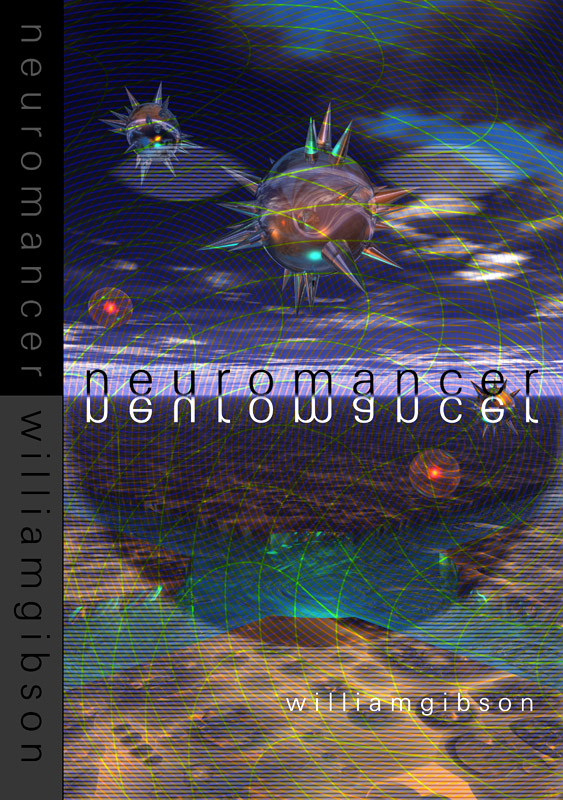
Illustration
5: cover of Neuromancer, novel by William Gibson.
In cyberpunk, cyberspace has been conceptualised as a net, matrix, metaverse and, universally, as a place constructed out of information. It is a vision of information organization, not a free and equally open, rather an economically divided space, with various types of access to knowledge and information. In cyberspace live bodiless consciousnesses, and it is made of information offering great power to those who can manipulate it. Entering the cyberspace consciousness become disembodied. Today, the Net is not a world of disembodied consciousnesses having access to the total sum of human information, but of “myriad acronyms, corporate rivalries and gradually growing sources of information and opportunities to communicate with other humans”. John Perry Barlow seem to be the first who used the Gibsonian term cyberspace in connection to existing computer networks, and while many have now recognised that joining together the visions of cyberpunk to the reality of networks creates a concept of cyberspace as a place that currently exists, the central insight of 'Barlovian cyberspace' is that whatever science fiction imagines might be possible, some of its fantasies have limped into real lives, no matter how deeply impoverished the textual and graphical level seem to be compared with Gibson's cyberspace or metaverse of another cyberpunk author Stephenson. In other words, “here we find a cyberspace in which fictional ideas inspire the construction of real computer interaction, which constitutes new networks that, in turn, inspire new fictions” (Jordan, 1999).
For Tim Jordan the power and paradox of cyberspace is its ability to liberate and dominate simultaneously. It more and more appears that cyberspace, the Net and digital communication offered a complex new world in which the individual, the social and the imaginary parts of the human[ity] could suddenly redefine and reinvent themselves. The matrix of simulation, to important extent controlled by individuals and virtual communities themselves, was an opportunity to create new social conditions, conduct cultural experiments, but above all create virtual, but yet real-simulated environments, fully suited to the needs of inhabitants. Dreams could be realized within a simulation, while simulation has been becoming the only real. In other words “unreality no longer resides in the dream or fantasy, or in the beyond, but in the real's hallucinatory resemblance to itself.” (Baudrillard 1993).
The impact open source and free software had in the world of code, in fact its fascinatingly tremendous functional and ethical power it had on lives of the significant amount of people, brought in the attention of social and cultural theorists, postmodern writers and contemporary thinkers to ask whether its model can be translated out from purely software engineering circles. It quickly became evident, especially by understanding software as something that more and more permeates the lives of all, that (1) even by being confined to software engineering it is increasingly influential in other realms of people’s lives, and (2) that it has already inspired number of non-software projects. Exemplary of this are the efforts of German-based initiative, or rather a debate circle, a mailing list ‘Oekonux’, which already had two conferences and are preparing a book. The idea behind the philosophical debates is the question if the way how operating system Linux has been created can be applied to economy and society at large.
The other trend that in fact ‘radio-activated’ communities around number of cities worldwide are open wireless networks. One of the greatest messages that free software and open source brings across is that openness and sharing in digital information world does not necessary mean loss of property, and further, that digital property is much more beneficial to humanity when it is freed and disclosed then when it is hidden behind high fences.23 In this sense, and within context of a public free-licensed radiowave band at 2.4GHz, initiative sprung up that encouraged installation of wireless equipment that enables network connectivity of computers in smaller neighbourhood radius and thus connecting local meatspace communities without the need for high investment and nationwide ISPs. “A broadband telecommunications system, built by the people, for the people” (Negroponte 2002)Even more, users of such equipment are encouraged to open wireless nodes for free access to local services, including the gateway to the Net. Such practice, which has proven to become widespread, is directly connected to the spirit of open source and free software.
“The Internet is, above all else, a cultural creation,” wrote Manuel Castells, one of least utopian nor dystopian sociologists who researched Information Age that is cautious and wary of any form of ‘futurology’. Despite of strong privatization and commercialization of the Internet, its culture has proved to indeed be an open one. In June 2003 at the Open Cultures conference in Vienna, among various speakers and activist ranging from art curators to activist programmers from open squatted cyberspaces, a lawyer working for Free Software Foundation for free, Eben Moglen held a slow, extremely persuasive lecture24 in which he, after describing winning battles for free software called for liberation of hardware and bandwidth.25 The undeniable example of success of free software, resulting in fully operational and usable operating system with all applications a digitally-literate contemporary wo-man would need, with complete source code and ‘no strings attached’ for a full program-away, fully used in underdeveloped countries like India, proves that an open, sharing, freedom-loving attitude can and does bring about a greater social good. The Internet played unmistakably crucial role in establishing worldwide global resistance to privatization of human knowledge and thought, while opening a rhizomatic field, a plateau of liberated imagination for most daring mediated creativity and human expression. Combined with the incredible phenomenon of collectively developed and shared open source and free software, global connectivity emits a powerful message: indeterminacy of a creative.
In the early years of the phonograph in late 19th century, the music industry was dominated by the publishers of sheet music. With the start of 20th century the importance of recorded sound grew in the business, and about the end of the first World War records supplanted sheet music as the largest player in the music business. The business has largely been dominated and controlled by the record industry, as the economics of mass-production of copies allow the manufacture of valuable music recordings for a tiny fraction of their sale price. Throughout of its existence, there have been repeated allegations of illegal price fixing by the record industry. As put nicely by Simon Frith:
"The history of the record industry is an aspect of the general history of the electrical goods industry, and has to be related to the development of radio, the cinema, and television. The new media had a profound effect on the social and economic organization of entertainment so that, for example, the rise of record companies meant the decline of the music publishing and piano-making empires, shifting roles for concert hall owners and live-music promoters."
(Frith 1992)
The effect on social and economic organization of entertainment meant also profoundly different ways of consumption and shifting and sliding of values, signifiers and general semantics propagated by the recording industry. One of starting points in understanding of contemporary dilemmas the music and recording history face lies in its roots, in mechanical reproduction and repetition, a loop, radio-televised electromagnetic mantra, where art-work becomes a meme, audio-visual sign that through repetition hypnotises the mass audience. “Quantity has been transmuted into quality. The greatly increased mass of participants has produced a change in the mode of participation.” (Benjamin, 1935)
In fact, it is through the eyes of the Critical Theory that it is possible to understand the infotainment phenomena of the end of the 20th century, like for example the phenomenon of the celebrity among others. Despite of its critical extremeness, the concept, and Frankfurt school's further exploration, of the culture industry still enables an astonishing perspective into mechanics of mass deception and consumption. In an elaborate context Adorno and Horkheimer write: “The culture industry perpetually cheats its consumers of what it perpetually promises.” (Adorno and Horkheimer, 1944)
At the end of the century that state of recording industry is polarized between major five record and distribution companies – the majors26, and so called independent labels – the indies, which aren't, however, so independent. The latter often need to utilize the distribution channels of the majors in order to have a distribution at all.27 Despite of the fact that competition between the majors exists they are usually prepared to step together for the common cause – which would include lobbying for majors-favourable legislations, investing in copyright-protection technologies and mechanisms, and making sure small players in the industry do not become big and too threatening. This situation, of course, hints at a high level of monopoly by seemingly unconnected competitive companies, and thus at a concentration of power. The consequence is a very high cost of consumer products that are relatively inexpensive to make, and streams of profit that return to the major labels, “the bastions of wealth and prestige that have the capital to dominate the markets, from the airwaves to the chain stores and the networks of physical distribution.” (Alderman, 2001)
This domination of big players in the record industry, excluding authors, has been sustained by way of the particular shape of copyright legislation and crossnational conventions (e.g., Berne convention) that are increasingly seen as unprotective of author's rights and favourable of big-profit industry players. Indeed, it is a fairly overlooked fact that it was the publishers who pushed for copyright legislation in 17th century (Licensing Act 1662, Statute of Anne 1709) and their view was that copyright protection is something given to books published by authorized publishers (as opposed to ‘written by authors’). At first an excuse for state-approved monopoly for a work, the notion of authorship got further fuelled in romantic frenzy after cult of genius, giving the publishers opportunity to strengthen the case for protection of authors rights.
The very technology and reproduction-enabling inventions that had made the infotainment industries had continuously been their greatest fear and enemy of these same industries. Because for every new reproduction and transmission medium invented, the plateau of reproduction-monopoly control had to be expanded, which every time meant a possibility of breaking the status quo – a state of stillness within which consumer could be caught in a loop without a choice. If progress would stop, control would be perfectly exerted and profits would never cease. The smell of self-collapsing capitalism.
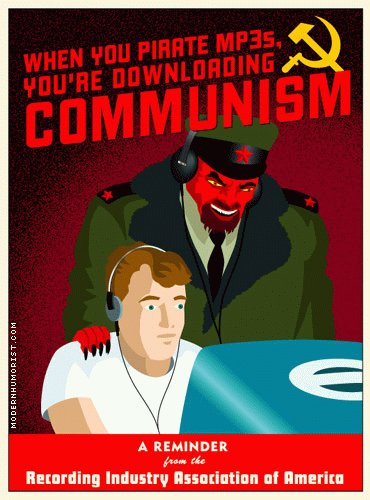
Illustration
6: A graphical meme circling the Internet
The recording industry, specifically the “big five”, use their own Recording Industry Association of America (RIAA) for watching after their common interests in United States and around the world. Since 1952 when it was formed it is lobbying Congress to pass favourable laws and taking on their adversaries, usually in court. Last decade has been especially difficult for RIAA. In fact, “the advent of the Internet has been a relentless series of wrenching headaches and embarrassing mistakes for the music industry” (Alderman, 2000), as suddenly something, that was confined to inscription in the very tangible plastic disc, suddenly lost the apparent need to be inscribed anywhere but could seemingly exist in-between, a part of the electromagnetic imaginary, in the non-existent, virtual place, the cyberspace, freed from the confines that encapsulated it from the days of phonograph. Or, paraphrasing John Perry Barlow, the author of Declaration of Independence of Cyberspace28, “the wine lost its bottle”. Music, in its nature already so intangible, has been freed from the cage, from the packaging that made the music market possible at all.
Similarly as with software, which is frequently considered as a collection of ideas, that found a life on its own when both realized concepts of the Cyberspace and Free Software caught their common resonating frequency, music became first kind of information other than the hyper-text, that ‘wanted’ to be free. Already in 1995, a former Microsoft VP Rob Glasser, with a great interest in the “nexus between media communications infrastructure and interactive digital technology”, introduced RealAudio to the Internet masses. However, Real was an Internet equivalent to radiowave broadcasting, and with target employ-ers being radio stations wanting their presence on the Net it represents a common mistake: replicating the mediated experience of already established media onto the Net. The cyberspace's most radical technologies re-define the simulation to create new conditions within which a more flexible environments are experienced. Real was embraced by companies, some netizens, but the revolution was about to come in form of mp3.
MPEG 1 Layer 3 format, shortened MP3, enabled high quality audio recordings, in near-CD fidelity, that were ten times smaller than uncompressed CD digital audio, was copyable costlessly between computers, over the digital networks. In contrast to Real, this was an equivalent of a compact disc with a twist: it was almost free.29 It could be copied indefinitely and nothing in the format specification could be set up that way that it would prevent it.30 Mp3 made music free, it made it behave like a pure information and therefore subject to the same “desire”, as understood by Barlow when he exclaimed that “information wants to be free”.31 (Barlow, 1994)
Music wants to be free as well, so after mp3.com – a site that offered many features to unsigned bands and artists (like cd-burning and ordering from merely uploading mp3s by artist) – the infamous Napster came along and provoked an uproar. After launch in June 1999, the application written by three young hackers who met on chat network (IRC) spread with lightning speed among all those who felt what music they thought they owned really ‘desired’ its own freedom. Napster avoided the problems of all previous efforts to use the Net as distribution for music files. These efforts usually included a technique of serving the music files from a publicly accessible web page or ftp server, waiting openly to be discovered by the RIAA that subsequently requested from Internet service provider to take the public files off-line and/or disable the user's account. The web is like a bulletin board. Napster on the other hand seem more analogous to telephone: by looking into yellow pages seeker of certain artist's music finds the right phone number that leads to the owner of a copy of music searched for. Napster connected music owners32 between themselves using their own computers as servers of music files as well as 'browsers' browsing other sharer's repositories of files. This approach bypassed the problem of ‘rented’ web-space from ISPs and therefore partially their control and censorship. The marginal cost of music on the Net became zero.
Napster had one flaw, however, that in the end helped the industry to shut it down (or bought out / found guilty of infringing copyright): the ‘yellow pages’. The very location of music files is at the user's home computer's hard drive. Napster is not an application specifically written for sharing “copyright infringing” material, and the exchange of files is being done over the Net itself and directly between users. None of these are directly involving Napster as a company into act of “infringing copyright” but one: keeping indexes of all files in the network on Napster-the-company servers – the yellow pages.
The field of debate is complex. From one extreme to the other, a cloud of ideas, propositions, efforts, business models are put forward, and most are looking for a solution that would offer intangible music to users, at the click of the mouse, and, at the same time, keep the industry alive. At the extremes, it seems that file sharers would be the happiest bunch in the world if the music industry would disappear, while the industry until not so long ago kept its eyes closed and wanted the Net to simply go away with all the troubles it is bringing. It is not quite clear why the industry is so inflexible to see a market niche in the cyberspace, but many attribute its slow “brain-pace” to a strong incentive to keep things as they were, to keep the status quo where consumers as well as artists can be exploited, deceived, blinded with advertising ploys, promises and celebrity spectacles.
After Napster number of second-generation peer-2-peer applications appeared. One of them was Gnutella, a Napster-like sharing program without the need for any central servers to store the ‘yellow pages’ of all the files. Gnutella worked in a similar way as the TCP/IP protocol: by telling the neighbours where is what and thus routing around. In other words, Gnutella users themselves with their computers serve as ad-hoc indexing services. This second generation of p2p technology was created with much deeper concern for privacy, control and evolution of the Net. Like for example another open source free software intended to be a publishing system completely resistant to any censorship, Freenet. In essence it is almost like web-page serving system with a difference that one file is shared among many hosts, therefore exists in many places at the same time while it is impossible to find out where exactly.
One of the main programmers that pioneered the internals of Gnutella network, sadly late Gene Kan testified before the Senate Judiciary Committee in June 2001, advising record industry that “the toothpaste is already out of the tube,” and it would be best to adjust their businesses to the new reality of file sharing, as opposed to ban it.33 And indeed, the very consequence of aggressive industry using every power it has to exert it on file-sharers and endeavours like Napster, is that file-sharers will themselves write sharing platforms completely decentralized and therefore impossible to shut-down or control. Which also means that very little chance is left to exert any copyright protection at all.
It is not characteristic of the recording industry only, but to software business as well, that one of strongest notions which self-referentially make its case is piracy. The buzz-word is also frequently used in form of ‘stealing intellectual property’, and ‘stealing music’. Some analogies go so far to compare copying a sound file to taking away money or stealing CDs from the shops. These acts are many time followed by rhetoric of ‘stealing from the artists themselves’ and ‘contributing to downfall of creativity’. These claims are part of ideological campain directed toward creating a psychological opposition in form of guilt and morality. It is believed that such tactic is part of pro-control and continuing exploitation propaganda. The argument against being that exchange of creativity, appropriation, quotation and reinterpretation have been and still are crucial elements of artistic and creative progression and evolution. Or as virtual reality prodigy Jaron Lanier wrote in 1999: “Piracy is a phony issue that record labels are hyping to rip off artists. Piracy has always existed. That's why there's a mountain of blank cassettes in any big electronic store.”34
The way music is consumed has changed radically in twentieth century. Technological inventions created a fertile ground for a wider and global distribution of creative musical works mediated through radio, television, vinyl record, tape, compact disc and other laser and digital formats for professional and consumer use. Musicians, composers, artists and bands were able to reach worldwide public. This was exceptional. However, culture industry is inherently problematic for its top-level strategies that result in deception of the public and artists themselves. The music industry today relies on legislation that is a direct descendant of the one pushed forward by publishing industry in seventeenth and nineteenth centuries to gain short term monopoly over the works of art with an excuse to protect author's rights. With advent of costless copying, instant worldwide communications, where singing and free speech in ‘real’ world has an equivalent of copying in cyberspace, and where thought is formalized identically as a sound recording, authors and consumers need to be protected from the industry's attempt to enforce monopoly on knowledge. The recording industry have increasingly shown that its interests lie in further exploitation of creativity and that the existence of author serves it only as an excuse for further granted monopolies on published works. Peer-2-peer networks have in contrast exemplified the use of tactical media35 to bypass and avoid mechanisms of cultural repression consequential of state-approved monopoly on creativity and knowledge.
After the huge expansion of the Internet and sudden availability of tcp/ip connectivity in America and Europe, through universities and commercial sector, demoscene ‘attitude’ and possibilities it offered quickly spread around. Anyone with an interest in music and bit of exploratory talents could soon enough find trackers, programs that enabled composition of music on a home personal computer, written by demosceners themselves. In the very beginning these programs that were in fact a combo of sequencer and sampler, even used the little computer speaker usually used for beeps for errors as an audio output. A more adventurous ones could put together a so-called covox, a knot of basic electronic parts and pieces soldered together and connected to ‘printer port’ that gave out a stereo phono-jack output. Extremely DIY and affordable for kids using Amigas and 386 IBM-compatible PCs.
As already described in chapter on demoscene, musicians within the demoscene began to form independent – tracking – groups that were releasing music in tracker module format over bulletin board systems and soon enough over the Internet. Many such self-thought computer musicians found out about the demoscene only after they have been already tracking music, which hints at a situation in which the demoscene ceases to be a prerequisite for one to become a tracking musician. Tracking scene showed examples of music groups using all the tactics of the demoscene but never really claimed belonging to it. However, the borders are extremely blurred on this issue. In any case, trackers used demoscene-created software, the same release-tactics, file-formats (tracker modules) and art-work attitude (free to use and distribute for non-commercial purposes, seek permission otherwise).
With introduction of mp3 format and greater availability of higher bandwidth, cheaper web space and on basis of already established tradition of full self-organisation the format of tracking groups usually consisting of geographically proximate friends started to change shape. Releases were not mostly from friends any more but were accepted from around the world as long as they passed quality or style control by the person running the group. Music was not necessarily composed using trackers but any kind of software and hardware, and distributed in form of mp3s put on the properly designed web page. The tracking group evolved into netmusic label. As Goodstuff, the netmusic guide – a 'high quality netmusic review site' – explains its philosophy: “this site is dedicated to quality music, made by musicians from the netmusic scene which has grown out of the international demoscene movement which started in the early '80s.” (konsumer.de/goodstuff)
One of many such netmusic labels was Theralite36, specialized in different electronic music styles like techno, breakbeat, experiments and drum'n'bass. It was run by one of the very few, if not the only one person from Croatia who was aware of netmusic scene. Named Argus, he sustained number of contacts with various musicians over the IRC chat networks to create a steady stream of releases in years from 1998 to 2000. Theralite released a bit over hundred releases in tracker module formats and in middle of 2000 switched to mp3 format of releases after which of 15 releases suddenly froze. The direction the label was run by Argus was acknowledged and very positively considered in the scene in terms of quality, regularity and clean visual representation with web page design that communicated dedication to releasing.

Illustration
7: Simon "h0l" Carless, photo by GameBoy camera.
Another example of highly acknowledged netlabel that traces its roots clearly in the demo/tracker scene while it is today possibly the most widely known and still active, is Monotonik and Friends37. Started as a loose independently run tracker group that quickly acquired members around the world while still considered and released submitted songs by non-members as guest releases, it was dubbed as ‘The Ninja Tune of the Net’ at some point. Its first releases in 1996 were in tracker module formats covering quirky breakbeat and techno influenced electronic music. The label had couple of 'restructurings' in terms of creating sublabels38 and even an initiative to morph into 'real-life' record label, the endeavour which was abandoned by the founder Simon 'h0l' Carless. Monotonik switched to mp3 format in middle for 99' and it keeps on regularly releasing music by independent artists once or twice a month. This project owes a bit of its reputation also to the fact that Carless was nominated as one of the experts of Prix Ars Electronica 2001 in category Net Vision/Net Excellence. In fact, Simon has a strong background as a scener and is now working in game industry in US. One of the interesting features of Monotonik releases or the way Carless runs the netlabel is a considerable number of releases from artists that also have releases at independent electronic “real-life” record labels. It seems that today (2003) the border between what has left of tracker scene and indie ‘intelligent dance music’ record scene has, at least through monotonik, become increasingly blurred to the point beyond recognition. The quote from ‘artist's news’ section of the website is exemplary:
“05.10.02: Not only was Lackluster's 'Grind', as originally released on Monotonik, played on Coldcut's seminal 'Solid Steel' mix show on the 29th September 2002 by Coldcut themselves (see tracklisting here), but also, the site credits it to Monotonik, and not DeFocus, who released the CD/vinyl versions of it. Heh. Lucky accident? Probably. Fun nonetheless. :)”
(monotonik.com)
A netlabel that also reflects certain efforts in connecting the net distribution methods with more tangible music products in a different way is Tokyo Dawn Records. Focused mainly on hiphop-influenced and jungle/drum'n'bass music it is run by Germany-based Prymer, who simultaneously runs the virtual netlabel and releases drum'n'bass singles at real-life record label. Since 1997 Tokyo Dawn Records released music in module format, later introduced mp3, but then sometime in 2000 Prymer “revamped” the whole back catalogue, deleted number of releases from ftp server, converted all mp3s to ogg format39 and labelled those in tracker module format as “open source”. As a matter of fact, the awareness of open source is not so surprising, as Tokyo Dawn Records web page features a full excerpt from Manifesto of Futurist Musicians by Balilla Pratella calling for rebellion against institutionalized forms of knowledge, creativity, tradition, and imitation of the past. The web page and other texts also clearly state that TDR is “an idealistic, non-profit-orientated, friendship-based group releasing free music on-line.”
From the roots completely other than the tracking and demo scene comes a netlabel of “freed” music called notype.com. At first it was meant to be a fully featured visual/press/audio net.zine in 1998, but other sections were eventually dropped and all that was left was an experimental “drones” releasing web-page. It is run by Canadian contemporary electroacoustic composer and graphic designer David Turgeon and in essence functions exactly the same way as previously described net.audio labels. It also features a short but strictly defined licence for use (as opposed to majority of netlabels which don’t use licences). Notype release experimental, mostly electronic music of artists from Canada and features diverse and ear-provoking array of music works. It is an example of a net.label whose starting points seem to be unrelated to the demoscene.
Another peculiar connection between on-line distribution channels is uncovered by an exploration of scene.org's ftp servers. One of the directories in the music section is called soulseek-records and it actually contains compilations released by Soulseek. Soulseek is in fact a file sharing P2P application which is an almost direct clone of the Napster. It uses one central server to store the indexes of user's shared files and didn't get shut down by the RIAA mainly due to the fact that most of music files traded on soulseek network come from the small experimental labels. It is an ideal place for leftfield electronica, off-beat hiphop and similar non-mainstream genres. Creators of the network decided to use peer-to-peer for what was mentioned many times in p2p debates: to promote unsigned artists. The mission statement of Soulseek Records is therefore to “prove that musicsharing is not the evil demon that many believe it to be, but rather that it can actually be the foundation for a positive new relationship between artists, labels, and listeners.” (soulseekrecords.com) This non-profit label actually realized a new way of virtual audio publishing, releasing compilations of unsigned artists, a way for which is strange that no one has really realized it until now. The peculiarity of finding a folder dedicated to Soulseek Records on scene.org's ftp server is based in the fact that the demoscene and its self-organization efforts were left unobserved, nonutilized and somewhat marginal.
The examples above show that the demosceners where probably the first to utilize the Net in a truly ‘d.i.y.’ manner in the context of free music. The step away from the demoscene origins was probably the main cause for blurring the boundaries with other creative “scenes”. The net.audio publishing also clearly demonstrates the bypassing of traditional music industry conditions and practices to freely distribute musical works without opposing it. Despite the cases when a virtual label removed releases from the Internet because the artist signed a contract with a record label40, the power of free distribution is evident. Even more, virtual audio publishing proves the possibility of blurring the borders between different movements, compatibility between ‘freed’ music labels and indie record labels, and potentials of the Net and programming to create new unrestrained networks of musical creativity. Freed music does not equal lost music, rather it represent new form of independence.
At of the public spaces where there seem to be much talk about the role of a laptop – lightweight mobile personal computer – in production of music is the ‘.microsound’ community. In essence .microsound is a mailing list dedicated to DSP (digital signal processing) aspects of manipulation of audio and 'contemporary' music composition practices. As the recently updated web-page proclaims, “.microsound presents itself as a forum for the discussion and exploration of a more general 'digital aesthetic' manifesting across a wide variety of styles and disciplines – from academic computer music to post-industrial noise to experimental ambient and post-techno.” The concept is to encourage topics of historical, conceptual, or experiential relevance to [post]-digital music.
The community produces traffic of approximately ten to twenty messages a day which range from short utterances as comments to other's posts, to fairly elaborate theoretical perspectives concerning contemporary phenomena, and announcements of events and playlists of radioshows. The name microsound can be traced to the title of the book by Curtis Roads that explores sound synthesis techniques and algorithms based on a new previously impossible sonic-manipulation paradigm: access to microscopic particles of sound by way of digital sound editing tools and dsp. The increasingly more powerful computers can use micro-samples as building blocks for the low-level sound synthesis. One of more known such techniques is called granular synthesis. Road's Microsound book is considered as an exhaustive, almost defining research in the field.
Evident from the messages in the mailing list, members of microsound are mostly musicians themselves and they almost exclusively use personal computer for sound synthesis, editing, sampling, sequencing, and composing. However, because the focus of musical composition are the intricate details of complex sound synthesis, sometimes sourced/generated exclusively in the digital domain, in other cases field recordings or samplings being subject to a process of extensive deconstruction, the choice of software and especially its flexibility becomes of great importance. Most of consumer-market music software is created to be easy to use, offering predictable results and quickly deployable presets and banks of sounds. These tools do not offer enough flexibility to explore the field of experimental sound synthesis. .microsounders therefore choose a rather flexible environment that would enable great number of combinations, linking components, sound sources, waveform generators, and mathematical functions, through a process similar to patching cables on old modular analogue synthesizers. Which is precisely what Max/MSP manages to deliver in digital domain. It is in fact an object-oriented programming environment that uses graphical representation of mathematical functions, sound in/outputs and generators to allow for developer to use and connect them in indefinitely different and any desired ways. With its basic interface elements like number boxes, buttons, sliders, and simple inter-connections, it enables high level of innovation on multiple levels: sound synthesis, time, interaction and performance level. It also enables for a path to be exported as a standalone application that could be run on other computers without the need for the native application.
With eliminated need for external musical equipment (apart from very useful one or two small midi controllers), composers, that long ago became synonymous with musicians and vice versa (while being at the same time programmers), have therefore moved their entire studio into computer environment, onto the digital desktop. Furthermore, those who were performing and touring, or any way travelling, quickly understood the ultimate most logical solution: the laptop. It sounds scarily similar to advertising campaigns with phrases like “all in one solution”, however after more than thirty years of increasing informationalization of human activities, if not total computerization, the laptop as a device represents the ultimate multi-tool for communication, expression, work, and entertainment. And microsound musicians use it.
Apart from sharing experience, knowledge and much talk on “laptop musician”, microsound members also collectively collaborate in microsound on-line music projects. These usually revolve around a particular issue mostly raised in the discussion and called for by the owners of the list. A call is made with instructions which sound sources, techniques and processes are required to utilize and to upload finished works to microsound server in mp3 format. Not long after a project web-page is made with all the works available for download. Virtual audio publishing. One such example is The McDonna Project, A Microsound Reconstruction in which artists use and deconstruct samples from Madonna on-line remix project and feeds off the discussion on effects and tactics of most powerful sign[ifier]s of mass produced popular culture artefacts and phenomena: Madonna and McDonald's. (microsound.org/mcdonna)
One of the co-founders of .microsound project is Kim Cascone, a sound artist with background in music and electronics and more than 15 released albums of electronic music. He also writes for Computer Music Journal and Artbyte Magazine, performs with laptop, gives workshops on Max/MSP and writes about glitch and laptop music. His writings on usage of a laptop by musicians is geared towards strong opposition against popular culture. He sees laptop music and performance in a context of “aesthetics of failure”, so called post-digital music that emerges from the failures of digital technology: glitches – the source for new sounds. The glitch music movement of digitally fully literate artists is closely connected to power tools combined with the Net: “Computers have become the primary tools for creating and performing electronic music, while the Internet has become a logical new distribution medium. For the first time in history, creative output and the means of its distribution have been inextricably linked.” (Cascone, 2000) In another paper Cascone writes that laptop music is a result of rhizomatic growth, the consequence of technology that liberates the user and changes the way they organize their work (Cascone, 2003). He observes the audience reactions to a laptop performance and finds it as a site of conflict in which society of spectacle, counterfeiting aura and passivity of audience interact and provoke in a mix. For Cascone laptop musician – with his motionless performance – represents parasitic resistance to super-culture pop industry.
Use of mobile computing, however, exists in many different cultural settings. One example is “Share”, a New York weekly Sunday gathering of portable equipment and its creative owners for an audio-visual feat in a three room bar featuring live performances, real-time video-art mixing and laptop music-jamming using various server software. As their web-page describes:
“open jam / walk-in sets: prepared and spontaneous music from 4+ simultaneous performers in 3 rooms. bring your laptop/ gameboy/ groovebox/ keyboard and an rca or 1/4" cable to join. this is the time and place to: perform a pop song you've written, try out that new max patch or software, hear your composition on a large sound system, improvise rhythms or melodies, get feedback on your latest project.”
(share.dj)
Illustration
8: Laptop performance at Share, NY.
The ‘laptop music meme’ also caught bigger institutions, as ICA, the London's Institute for Contemporary Arts, in 2001 and 2002 staged series of concerts called Laptops Live that featured established names of contemporary electronic music scene where most of them indeed used laptops for their performance. However, the use of laptops is much more striking at occasions when its mobility is pronounced by the context. For example ‘Smallfish’ is indeed a small record shop in central London that about bimonthly features a free “in-store” performance, frequently by more than one artist. Invited to bring their favourite drink and allowed to smoke, interested audience stand by the cd-racks and enjoy a performance by an artist nodding her head to the beats in a glow of laptop screen standing behind the till. Everybody enthusiastically applaud at the end, and while the next artist already starts, the previous mingle into the audience to freely chat with her listeners.
In summer of 2003 Arden Hill, Canadian minimalist sound maker and painter had a European tour. He performed in London, Amsterdam, Paris, Berlin, Vilnius, Copenhagen and Ljubljana. He is member of microsound community and so far – until 2003 – released three full albums, and appeared on more than ten compilations. His tour seemingly wasn't intended to make any money but just to make it through without any serious financial investments and more importantly to meet new people and see new places. For his performance he used a laptop and external mouse. Software he used was Audiomulch, a shareware interactive musician's environment software whose beta-stage versions are a free download.
Virtual .micromusic community, New York’s Share meetings, London’s Plug’n’Play self-organized events and Smallfish in-store performances all represent a real practical example of contemporary new music culture. Through the laptop music emerge musicians that, far from being limited to laptop performances, visibly communicate through electronic mailing lists, compose sound works and create own patches, customized software with[in] a personal computer, and share their musical and non-musical knowledge and achievements through the Net.
However, it is important to note that, as Tobias c. van Veen puts it, “laptops and glitch music have become a site of a nano-niche moment of theoretisation on behalf of both academics and artists.” In his immensely challenging paper Laptops & Loops, Veen articulates our reasons precisely for using the seemingly trendy notion of a laptop: “what is at stake in the interaction between artist and laptop has become quickly realised as a flashpoint for the ubiquitous question concerning technology.” The use of general computing mobile technology in various social settings, for performative, educational and creative purposes seems to be another step closer to the extension of human with a machine, or perhaps even ghost in the machine. Laptop evokes a, possibly, post-human moment when Russolo’s Art of Noises once again catch an opportunity to echo fascination with machines, or perhaps yet another voiced suggestion of Heideggerian dialogue between Nature and Technology.
“The role of the laptop in artistic production has become ubiquitous: it records, transmits, receives, creates, edits, effects, and performs; it is mobile, fast, and light. For the audio-artist, experimental electronic musician, video-producer, or visual artist working in new media, the laptop is increasingly becoming indispensable device.”
(van Veen 2002)
In the present text, we explored the terrain of conditions for creative and technological practices in the light of five activities that a musician conducts with help of general purpose processing device connected to digital networks. In conclusion, they are layed out here.
Research
The information age represents an era when, among others, the knowledge that needs dissemination will be disseminated. As never before in human history, an individual with a personal computer and Internet connection has access to body of knowledge previously unimagined. Being on-line can be thought of as ‘being in the classroom’. Despite of Internet explosion being largely a consequence of its privatization, the meme of ‘information wants to be free’ never left the building. Thanks to numerous individuals who continuously publish and communicate their inventions, papers, documentation and explorations on the Internet, and campaign for liberties like free software and free speech, a netizen can now learn almost without limitations, and for her, indeed, information overload is an obligatory experience.
Composition
The freeing sounds by mid-century composers opened a door not only for free compositions, but also for free composers. The re-questioning of art brought in new types of artists. By introducing indeterminacy, composers gave performers power to compose, and by using machines musical performer became somewhat obsolete. Music-making has become possible for anyone with an interest in bouncing samples around in trackers, manipulating sounds and sequencing them or perhaps leaving them to random triggering by customised patches. Musicians grew increasing interest in maths, programming and algorithms, to create new varied compositional methods. “Composition is inscribed in the permanent fragility of meaning after the disappearance of usage and exchange. It is neither a wish nor anxiety, but the future contained in the history of the economy and in the predictive reality of music.” (Atalli 1985)
Innovation
The advent of general purpose processing device – a personal computer – created a free space for creation of musical tools, compositional software, experimental synthesis and dsp plugins. It created plateaus open to re-appropriation of code, programming routines and experimental patches, with help of ‘intelligent’ software that enables creation of new applications. The composer is free to create her own versions of tools, customised for composition or performance. The instruments morph and switch at fingertips at virtually lightning speed.
Performance
With its mobility, laptop frees the composer, the performer, the band, from bulk of synthesisers, pianos, drums, rack of samplers and effect units, and sends her – the technomad – to perform, sometimes motionless to challenge the aura of the spectacle, sometimes immersed into the ocean of her own sound, like it would be a true gibsonian cyberspace of avatars, and perhaps indeed the network traffic from the venue’s open wireless network is used as data for control information within the digital patches. The glowing of lcd screens illuminate concentration, and reveal nothing more than a hint at interface with buttons, sliders and numbers. Or perhaps a black screen with a command line is projected onto the wall demonstrating a custom built music performance tool. Performance as exploration of technology.
Distribution
Using the Net as a network for free distribution of creative works through various protocols and services enabled musician to find her audience and offered possibility to listener find her music. Music is liberated from its physical media, entering the cyberconsciousness only to re-enter the free flow of appropriation, exchange and redefined referencing. Instant virtual publishing bypasses the middle-man, the manufacturer, distributor and seller, to spread the non-exclusive sound in a non-exclusive way. Even ‘the exclusive music’ – the protected and guarded – is almost militantly liberated, as in a battle for air, reinstating the right to listen by throwing ripped digital data into the sea of binary bits and bytes disseminated by tcp/ip protocol to be put to seemingly primary use: ensemenating41 the musical minds: “Let loose the echoes of difference. They need no guidance, nor control nor mastery or strict prescription, but space and time to plat out their differing echoes” (Veen 2002)
Laptop music is an un-generalized, un-patterned and non-uniform cultural phenomenon, a product of rhizomatic conditions, a musical practice, an attitude, almost state of mind, consciously or unconsciously redefining the techno-cultural sound scape. It is a new mode of musicianship: fusing self-research, composition, innovation, performance and distribution in a single technological device connected to digital networks.
Adorno, T. (2002). Essays on Music. Berkley and London: University of California Press
Adorno, T. & Horkheimer, M. (1944). ‘The Culture Industry: Enlightenment as Mass Deception’. Dialectic of Enlightenment. http://marxists.org/reference/subject/philosophy/works/ge/adorno.htm
Alderman, J. (2002). Sonic Boom: Napster, P2P and the Future of Music. London: Fourth Estate
Alvesson, M. (2002). Postmodernism and Social Research. London: Open University Press
Atalli, J. (1985). Noise: The Political Economy of Music. Minneapolis: University of Minnesota Press
Babbitt, M. (1958). ‘Who Cares if You Listen?’. High Fidelity. 8/2. reprinted in Schwartz & Childs. (1967). Contemporary Composers on Contemporary Music. pp. 234-50. New York: Holt, Rinehart & Winston.
Barlow, J.P. (1994). ‘The Economy of Ideas’. Wired. 2.03. http://www.wired.com/wired/archive/2.03/economy.ideas.html
Baudrillard, J. (1993). Symbolic Exchange and Death. New York: Sage
Benjamin, W. (1935). Work of Art in the Age of Mechanical Reproduction. http://www.student.cs.uwaterloo.ca/~cs492/Benjamin.html
Borzyskowsky, G. (1995). ‘The Hacker Demo Scene and It’s Cultural Artefacts’. Perth, Australia: School of Design, Curtin University of Technology.
Cascone, K. (2000). ‘The Aesthetics of Failure: 'Post-Digital' Tendencies in Contemporary Computer Music’. Computer Music Journal. 24:4 Winter. Massachusetts: MIT Press
Clayton, M. & Herbert,T. & Middleton, R. (Eds). (2003). The Cultural Study of Music: A Critical Introduction. New York and London: Routledge
Dack, J. (1994). ‘Pierre Schaeffer and the Significance of Radiophonic Art’. Contemporary Music Review. Harwood Academic Publishers & Middlesex University Sonic Arts. http://www.sonic.mdx.ac.uk/research/dackpierre.html
Davies, E. (2002). ‘Recording Angels: Esoteric Origins of the Phonograph’. R. Young. (Ed). Undercurrents: the Hidden Wiring of Modern Music. London: Continuum/The Wire
Davies, E. (1999). TechGnosis: Myth, Magic and Mysticism in the Age of Information. London: Serpent’s Tail
Deleuze, G. & Guattari, F. (1988). A Thousand Plateaus. London: Continuum
Edles, L.D. (2002). Cultural Sociology in Practice. Oxford and Malden, MA: Blackwell
Frith, S. (1992). ‘The Industrialization of Popular Music’. J. Lull. (Ed). Popular Music and Communication. New York: Sage, pp. 51
Gere, C. (2002). Digital Culture. London: Reaktion Books
Himanen, P. (2001). The Hacker Ethic, and the Spirit of the Information Age. New York: Random House
Jordan, T. (1999). Cyberpower: The Culture and Politics of Cyberspace and the Internet. London and New York: Routledge
Kahn, D. (2001). Noise, Water, Meat: A History of Sound in the Arts. Cambridge: MIT Press
Lowe, J. Jim's Old Radios. http://www3.turboweb.net.au/~plowe/Radios/phonogra.htm
Maxfield, M. and Brown, A. (1997). Bepop Bytes Back (An unconventional Guide to Computers). Madison: Doone Publications
Naughton, J. (1999). A Brief History of the Future: the Origins of the Internet. London: Wiedenfeld & Nicholson
Negroponte, N. (2002). ‘Being Wireless’. Wired. 10.10 (October 2002)
Nyman, M. (1999). Experimental Music: Cage and Beyond. (2nd ed.). Cambridge University Press
Pavlicek, R.C. (2000). Embracing Insanity: Open Source Software Development. Indiana: Sams
Pritchett, J. (1996). The Music of John Cage. Cambridge: Cambridge University Press
Schoenherr, S. E. (2003). Recording Technology History Notes. http://history.sandiego.edu/gen/recording/notes.html
Seidman, S. (1997). ‘Relativizing Sociology: the Challenge of Cultural Studies’. E. Long. (Ed). From Sociology to Cultural Studies. Oxford and Malden, MA: Blackwell, pp. 37 – 61
Stockhausen, K. (1991). Stockhausen on Music: Lectures and Interviews. London: Marion Boyars Publishers
van Veen, c. T. (2002). ‘Laptops & Loops: The Advent of New Forms of Experimentation and the Question of Technology in Experimental Music and Performance’. Conference Paper. Universitiy Art Association of Canada, Calgary
van Veen, c. T. (2003). ‘Hearing Difference: The Seme’. Conference Paper. International Conference of the International Association for the Study of Popular Music (IASPM), Montreal. Posted to Nettime, July 7, 2003
http://creativecommons.org – Creative Commons is a non-profit corporation founded on the notion that some people may not want to exercise all of the intellectual property rights the law affords them. CC intends to help people express this preference for sharing by offering the world a set of licenses on our Website, at no charge.
http://defacto2.net – an archive of demoscene and cracking scene related texts, magazines and screenshots.
http://digitalconsumer.org – an organization working towards a positive assertion of a consumer’s personal use rights.
http://gnu.org – the GNU project was launched to develop a complete Unix-like operating system which is free software. Home of gnu general public licence.
http://jargon.org - the Jargon File, a comprehensive compendium of hacker slang illuminating many aspects of hackish tradition, folklore, and humour.
http://ojuice.net – the Orange Juice, an exhaustive information centre about all the activities related to the demoscene.
http://microsound.org – .microsound is an unmediated mailing list oriented toward discussion of the styles of digital and post-digital music promulgated by the proliferation and widespread adoption of digital signal processing (dsp) tools.
http://monotonik.com – monotonik and friends, possibly one of the most known on-line electronica .mp3 net.label.
http://notype.com – internet-based record label which hosts many artists, electronic for the most part, with a tendency towards more experimental forms.
http://scene.org – scene.org is a non-profit organization aimed at providing the 'electronic art scene' with a forum for communication and for sharing their work.
http://share.dj – Share happens every Sunday in New York and is an open jam for new culture lovers. Participants bring their portable equipment, plug into system, improvise on each others signal, and perform live audio and video.
http://soulseekrecords.com – Soulseek Records is an offshoot of Soulseek, a file-sharing application dedicated predominantly to the free trade of electronic music and the promotion of unsigned artists.
http://tokyodawn.org – the ‘nusouleclectic’ netlabel and worldwide artist network releasing mp3 and ‘opensource’ music.
http://wikipedia.org – wikipedia is a multilingual project to create a complete and accurate free content encyclopedia.
1Sophisticated in a sense of being intellectually appealing.
2After Cage experienced the deafness of anechoic chamber realising there is no such thing as true silence. Even in anechoic chamber he heard his own nervous system and thumping of his heart.
3On discussion on difference between experimental and traditional/avant-garde music see Nyman, Experimental music.
4Lecture in Essen: (1) unified time structuring, (2) splitting (decomposition) of sound, (3) multilayered spatial composition, and (4) equality of tone and noise.
5Babbitt’s original title for his article was, in fact, “The Composer as Specialist”.
6Personal Computer is throughout here understood strictly as an affordable, general purpose, microprocessor-based computer intended for consumer market.
7The on-line hacker Jargon File, version 4.3.3, 2002, defines phreaking as the art and science of cracking the phone network (so as, for example, to make free long-distance calls).
8William Gibson's Neuromancer and Bruce Sterling’s Mirrorshades collection being the prime and most influential examples.
9Quality of a “release” is determined by number of factors, but mainly by size and functionality of the “pack”. Pack is re-packaged software that installs and works on user's computer without copy protection.
10Technically, routine is a set of instructions in computer program which is separated from other code to reduce redundancy, and called by other subprograms or other parts of the program (wikipedia.org 2003)
11The Jargon File defines bloatware as software that provides minimal functionality while requiring disproportionate amount of disk space and memory (Jargon File, version 4.4.4, 2003)
12A partial insight into which is the on-line demoscene photo archive at slengpung.com
13As of 2003.
14But also of the gaming industry with, in fact, the demoscene in important connection. In fact number of demosceners find their work in the gaming industry.
15This is indisputably demonstrated by the on-line publicly accessible server scene.org (and its crossnational and cross continental mirrors) which served 22 million files from November 1999 until September 2003 and is maintained by a voluntary team of around 15 members from around the world with help of various sponsors.
16Like for example PRNET and SATNET.
17A hacker is “a person who enjoys learning the details of programming systems and how to stretch their capabilities, as opposed to most users who prefer to learn only the minimum necessary. Or somebody who programs enthusiastically, or who enjoys programming rather than just theorizing about programming.” (jargon.org)
18Source code: the form in which a computer program is written by the programmer. Source code is written in some formal programming language which can be compiled automatically into object code or machine code or executed by an interpreter [The Free On-line Dictionary of Computing (17 May 2003)]. In effect, access to source code in necessary in order to change, fix, update or improve the program.
19In contrast to works which are in Public Domain whose modified versions can be re-licensed under a different “non-free” licence.
20To be sure, Stallman and idea of free software is not against business, but only against proprietary software.
21Yes, this paper was researched and typed using exclusively free software.
22In 1976 Steve Wozniak built, using the information shared freely within the Homebrew Computer Club, a group of hackers in the Bay Area, at the age of twenty-five, the first personal computer for the use of people without engineering degrees, the Apple I. (Castells 2001, in the epilogue to Himanen, The Hacker Ethic 2001)
23Of course the issue of privacy and anonymity is part of different attitude among hackers and alike. In essence these issues are highly regarded as important in a sense that the right to privacy and anonymous communication is one of most basic rights a netizen must have.
24http://opencultures.t0.or.at/oc/participants/moglen/video.ram
25See opencores.org and consume.net,.
26The majors, also commonly referred to as the “big five”, are Sony Music, Universal, EMI, Warner’s Brothers, and MBG (Bertelsmann Music Group)
27Apart from that, many smaller labels are increasingly owned by the big five: Geffen, Atlantic, and Virgin records have been brought under greater umbrellas of Universal, Warner's, and EMI, respectively.
28http://www.eff.org/~barlow/Declaration-Final.html
29As it turned out, after the mp3 explosion on the Net, Fraunhoffer Institute, who created the codec and its compression algorithm wanted revenue from the mp3 boom and started charging the makers of software encoders a special licence. Consequentially, this tactics disabled any possibility to make a m3p encoder that would be Free Software.
30As opposed to Real streaming situation that would enable listening to the audio streams but possibly disable saving or copying music.
31Of course, Barlow is not the original author of the attitude. The understanding that information wants to be free has been around from the early beginning of communication networks.
32Here the seemingly “wrong” use of owner of music is deliberate as an opposition to rhetoric of the recording industry, who are continuously deceiving the public into thinking that ownership of ideas [f.k.a. Intellectual property] can be treated the same as ownership of the real estate property. It is a much complex issue than many want to present.
33Wired News, 09 Jul. 2001, Quiet, Sad Death of Net Pioneer. wired.com
34New York Times, 9 May, 1999. Jaron Lanier: Piracy is your Friend.
35“Tactical media: the tangential, mobile infrastructure of a counter-discourse to conventional national and international broadcasting.” (Patricia Spyer)
36Its original address was theralite.avalon.hr, which is not available anymore. However, archive.org gives an insight into the web page while the releases are available at ftp.scene.org
37monotonik.com
38In fact, the label was at first called only “mono” and later split into breakbeat part “mono211” and more techno, electronic experimental and idm (intelligent dance music) part “monotonik”.
39Ogg extension belongs to the first open source free multimedia audio and video compression codec developed by vorbis.org. It is meant to replace mp3 and number of proprietary video codecs.
40Opposite cases exist where record label released a full-length album from which about 50% of material was previously released on virtual music labels. Specifically Lackluster's Container at Defocus Records and Esem's Serial Human at Merck Records.
41Tobias C. van Veen’s concept of sonic meme.